

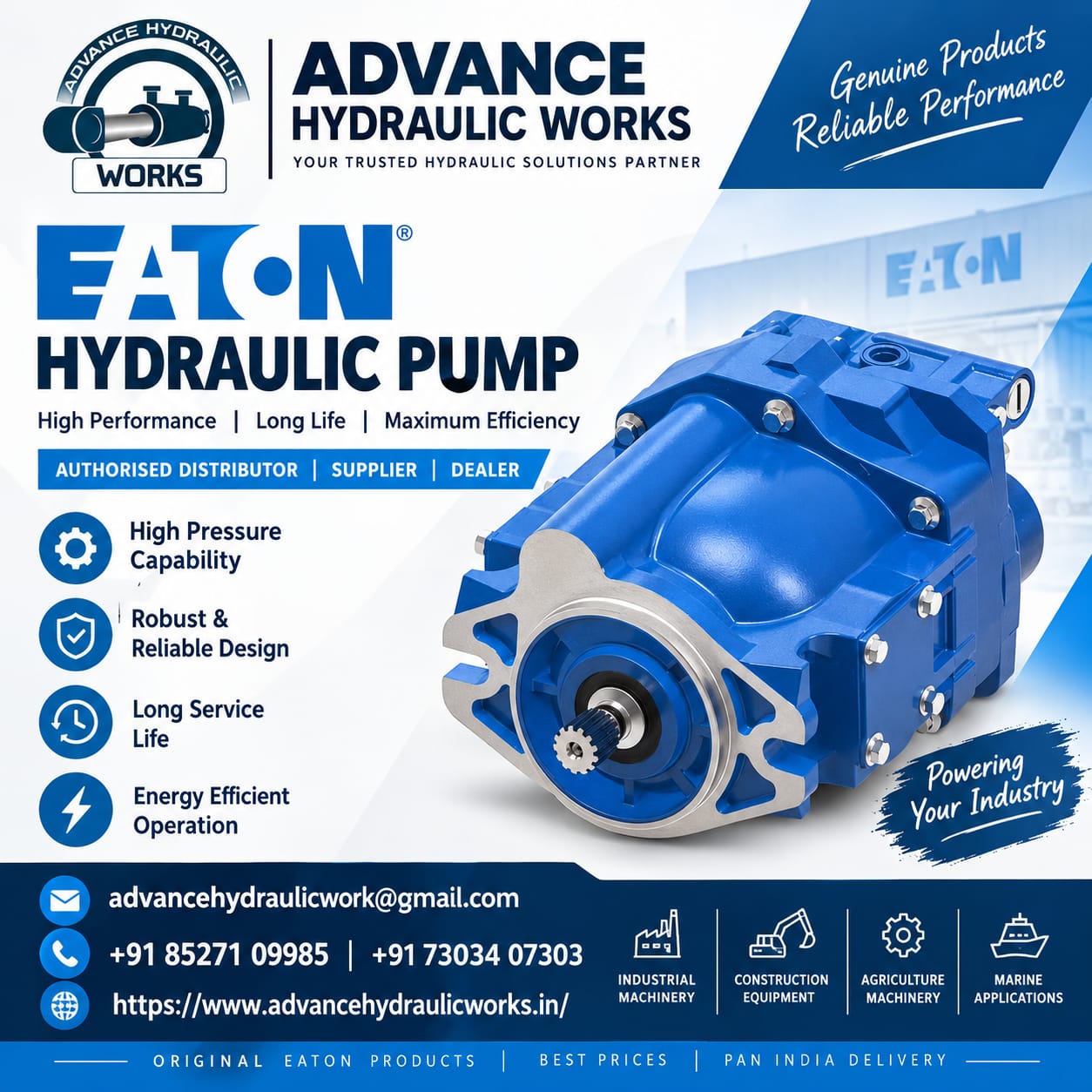
Eaton hydraulic pump and Eaton Vickers vane pump:
If your Eaton hydraulic pump is
losing pressure, running hot, or making a noise it didn't used to make, the
question isn't really "what's wrong with it" — you can usually guess
that part. The real question is whether it's worth fixing or whether you're better
off swapping it out. That decision gets made badly more often than it should,
usually because someone's in a hurry and just orders whatever the last supplier
quoted.
Why
you'll see both "Eaton" and "Eaton Vickers" on the same
pump
This trips people up constantly, so
it's worth clearing up first. Vickers dates
back many years before it was acquired by Eaton Corporation — along with
Aeroquip — in April 1999. Older pumps and plenty of modern-day catalogs still
convey the Vickers call or nameplate, which is why you'll find "Eaton Vickers Hydraulic Pump" and "Eaton
Vickers Van Pump" often
used in the Indian market in exchange for each other. They are the same
lineage..
If your pump has a Vickers tag on it, parts and cartridge kits are generally
still sourced under the Eaton Vickers designation.
The
failure signs worth paying attention to Loss of pressure or flow
A
vane pump that used to hold pressure fine and now can't is almost always
wear-related — the vanes, the ring, or the cam surface inside have worn enough
that internal leakage is eating your output. Piston pumps exhibit the
same symptom for a specific purpose: a worn piston or a scored swash plate.
Either way, that's a symptom that's most customarily replaced with an entirely new
pump when a cartridge kit swap could solve it.
Noise,
heat, and vibration
A pump that's suddenly noisier,
running hotter than it used to, or vibrating more usually means cavitation —
air getting pulled into the suction side — or a bearing that's on its way out.
Cavitation It's worth checking the cavitation before you touch
the pump: a clogged suction hole or a suction line with successive leaks will
just ruin a brand-new pump as fast as an older one.
Contaminated
or discolored oil
If the water
oil coming out of the machine is black, smells burnt, or has visible metal
particles in it, it truly is no longer a pump problem you fix with help
changing the pump yourself Contaminated oil often precipitated the pump in the
first place
Repair
or replace — how to actually decide
There's no single rule here, but a
few things genuinely matter more than the others when you're deciding:
How
old is the pump, and how hard has it been run? A pump on its
second or third rebuild, run continuously in a multi-shift operation, is a
different case from a pump that's five years old and lightly used.
Is
the housing or shaft damaged, or just the wear parts? Worn vanes, rings,
and seals are routine rebuild items. A scored housing, a bent shaft, or a
cracked casing usually isn't worth machining back to spec — replacement is
cheaper and more reliable.
Genuine
What must
happen for it? Genuine Eaton Vickers cartridge kits for the unusual collection of V10,
V20, 2520V and 3525V are widely stocked in India, making the remanufacturing
candid.For older or less common series, sourcing the proper refurbishment kit
will take longer than sourcing a substitute pump, which changes the math even
assuming the pump itself is high quality in another case.
What's
the downtime cost while you wait? A rebuild that takes a week isn't a
good trade if the line is down and losing more per day than a new pump costs.
This is where a lot of "repair" decisions really get made — not on
the pump's condition, but on how much waiting the operation can absorb.
As a rough guide: if the failure is wear-only and
the parts are readily available, repair is usually the cheaper and faster
option. If there's structural damage, or the pump has already been rebuilt more
than once, replacement tends to hold up better over the next few years.
What
a proper vane pump repair covers
A repair that's just "swap the cartridge and
send it back" isn't a full job. A proper rebuild on an Eaton Vickers vane
pump should include:
1.
Full teardown and inspection of the housing, shaft, and bearings — not just the
cartridge
2.
Replacement of the vane/ring/cam cartridge kit as a matched set, never mixed
with old components
3.
Shaft seal and O-ring replacement
4.
A test run under load, checking pressure and flow against the pump's rated spec
— not just "does it turn on"
5.
A check of the system it's going back into, since a pump that failed from
contamination or cavitation will fail again if the root cause isn't addressed
If a repair shop skips the test-under-load step,
that's worth asking about before you accept the pump back.
FAQ
section
Is
an "Eaton Vickers" pump the same as a "Vickers" pump?
Yes,
in practice. Vickers was an independent manufacturer that Eaton acquired in
1999. Older nameplates and some current parts catalogs still use the Vickers
name; both refer to the same product line.
How
do I know if my vane pump needs a full rebuild or just a cartridge kit?
If
the housing, shaft, and bearings are undamaged and the failure is limited to
worn vanes, rings, or seals, a cartridge kit swap is usually enough. Structural
damage to the housing or shaft calls for a fuller rebuild or replacement.
How
long does a typical Eaton Vickers pump repair take?
It
depends mainly on parts availability. Common series with readily stocked
cartridge kits can often be turned around in a few days; less common or older
series can take longer if the kit has to be sourced.
Can
a repaired pump perform as well as a new one?
A
properly rebuilt pump — matched cartridge kit, new seals, tested under load —
can perform close to new spec for the wear-related parts of the pump. It won't
fix structural damage, which is why inspection before repair matters.
What
usually causes premature pump failure?
Contaminated
hydraulic oil and cavitation from a restricted suction line are the two most
common causes seen in the field, more often than simple old age.
Do
you repair both vane and piston type Eaton pumps?
Yes,
both vane pumps (V10, V20, 2520V, 3525V and similar series) and piston pumps
are handled.
