

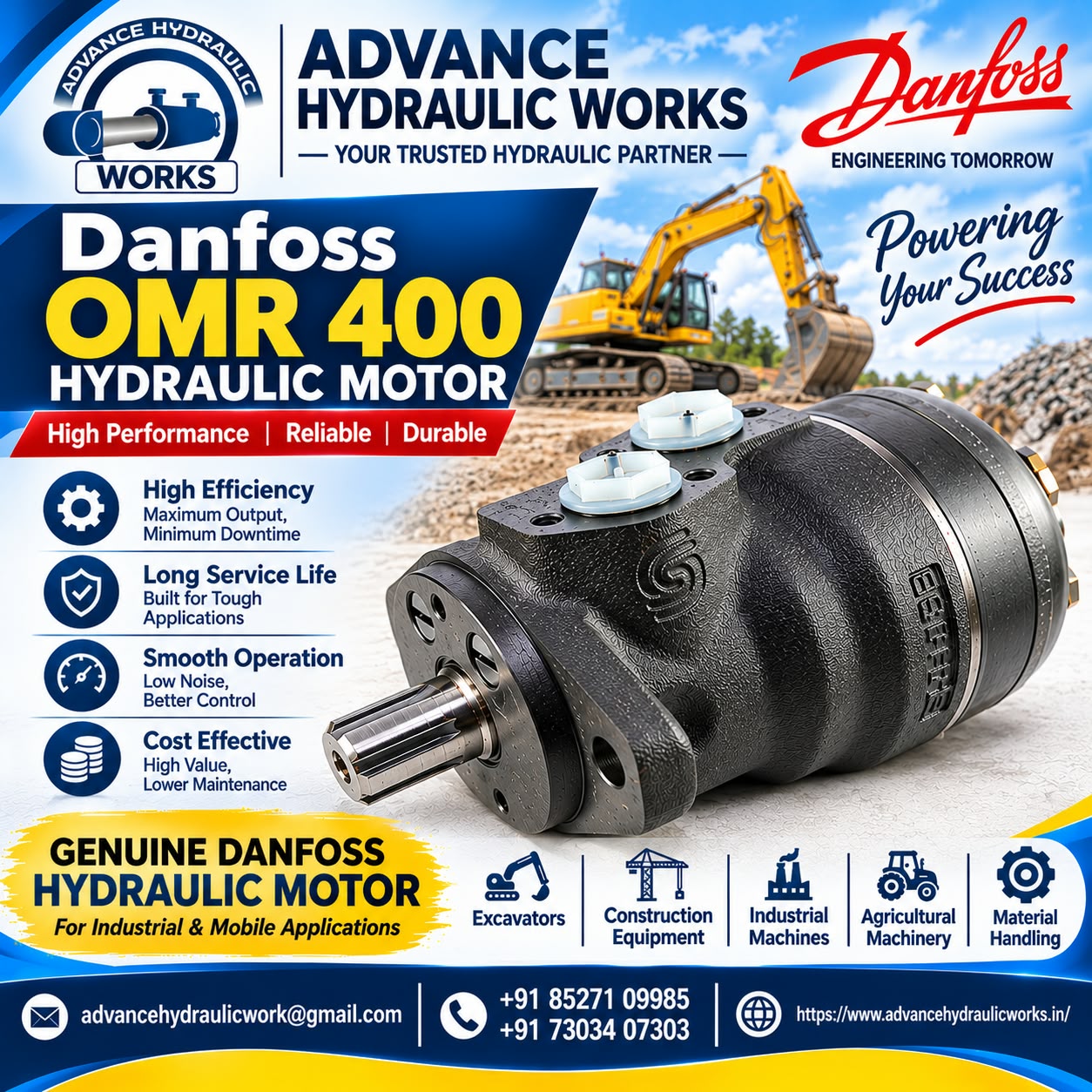
Danfoss OMR 400: what it is, what replaced it and how to size it
The Danfoss OMR 400 is the biggest motor people ask about in this range, and the hardest one to pin down. It’s no longer in production, the replacement comes in several shaft versions, and “400” is also the name of motors in other Danfoss series. Size it wrong and you either overspeed the machine or run out of pump. Advance Hydraulic Works handles hydraulic pump and motor repair and supply from Delhi NCR, and this is how we’d work through it with you.
Danfoss OMR 400 motor: what the listings tell us
A Czech reseller lists the OMR 400, product ID 11004882, at 400 cm³ displacement. It states that the motor is no longer in production and has been replaced by the OMR X 400, part number 11185535, made by White Drive Motors & Steering, formerly Danfoss and Sauer-Danfoss.
I couldn’t find a datasheet row with continuous speed, torque and pressure for the OMR 400 itself. The Danfoss OMR table for 32 mm and 1 1/4 in shafts runs from size 50 to 375, so the 400 shows up in reseller listings, not in that table. For the OMR X range, the dealer lists a maximum of 200 bar continuous, 400 N·m continuous torque and 60 litres per minute continuous flow, across all sizes. Treat those as ceilings, and get the datasheet for your exact part number.
Danfoss OMR 400 hydraulic motor: how it differs from the OMR 315
Displacement is the clean comparison. The Danfoss OMR 400 displaces 400 cm³ per revolution and the OMR 315 about 315 cm³, so the 400 is about 27% larger.
That has two effects. At the same pressure, the 400 produces about 27% more torque. On the same flow, it turns about 21% slower. At 60 litres per minute the 400 should run near 150 rpm, since 60,000 ÷ 400 is 150, while the 315 runs near 190 rpm. If your relief valve is capped and you need more torque, size up. If you need speed, don’t.
Who makes the Danfoss OMR 400 now?
White Drive Motors & Steering makes the OMR X 400. The dealer describes it as a new generation with up to 15% more torque than the old OMR design. It lists several versions: 11185535 with a 25 mm straight shaft, and 11186153 with a 1 inch straight shaft and a 2-bolt A flange. A listing for 11140224 shows a 1 inch shaft on a different mounting pattern.
So the shaft and flange decide which replacement fits, not the displacement. Send Advance Hydraulic Works your nameplate part number, shaft and flange, and we’ll match them before you order.
What the replacement costs
These are overseas listings. None is an Advance Hydraulic Works price. The OMR X 400 itself is price on request at the Czech reseller. For scale, one Dutch shop lists the OMR X 160 at €399.15, the OMR X 250 at €418.94 and the OMR X 315 at €433.00, with the 315 listing stated excluding tax.
Other series called “400” cost far more. An OMT 400, part number 151B3004, is listed at €1,399.48 excluding VAT, and an OMS 400, part number 257151F0605, at €1,200.49 including VAT. If a quote for an “OMR 400” lands near those numbers, check which motor it really is.
The method: duty, flow, pressure, version
Begin with duty, which is the torque, speed and pressure your machine needs continuously. Then check flow, meaning what your pump gives at that pressure, and pressure, meaning where your relief valve is set. Finish with the version: part number, shaft and flange from the nameplate. If the plate is unreadable, photograph the shaft and flange and send them to Advance Hydraulic Works.
A worked example
Say your drive needs about 150 rpm. On a 60 L/min pump, the OMR 400 gives 60,000 ÷ 400 = 150 rpm. The OMR 315 would run at about 190 rpm, around 27% too fast.
Now cut the pump to 45 L/min and ask for about 140 rpm. The 400 turns at only about 112 rpm, since 45,000 ÷ 400 is 112.5. The 315 turns at about 143 rpm, so it fits better.
Torque follows displacement. If the relief valve is capped, the 400 gives about 27% more torque than the 315 at the same pressure. These figures are illustrative, so use the datasheet for your actual motor, and send your numbers to Advance Hydraulic Works if you’d like a second look.
Implementation steps
- Photograph the old motor’s nameplate, shaft and flange before removal.
- Write down the full part number and note any drain port.
- Work out the speed and torque your machine needs.
- Check your pump’s flow and your relief valve setting.
- Send everything to Advance Hydraulic Works and ask what’s available.
- Ask the seller to state maker, part number, condition and warranty in writing.
- Compare the new motor’s plate, shaft and flange with the old one before fitting.
- Flush the lines, fit the motor, and run it unloaded first. Then bring it up to working pressure while you watch temperature and noise.
The mistakes we see most are ordering by the number “400” alone, ignoring the shaft version and sizing for torque without checking flow.
FAQs
What is the Danfoss OMR 400?
An orbital motor with 400 cm³ displacement. It’s no longer in production and has been replaced by the OMR X 400.
What is a Danfoss OMR 400 motor used for?
Low-speed, high-torque drives where a gearbox would add cost and size, such as conveyors, augers, sweepers and small wheel drives.
Is the Danfoss OMR 400 hydraulic motor better than the OMR 315?
It gives about 27% more torque at the same pressure but turns about 21% slower on the same flow. Better depends on your pump.
Has the Danfoss OMR 400 been discontinued?
A Czech reseller lists it as no longer in production and replaced by the OMR X 400, 11185535. Ask any seller exactly what they’re offering.
Can Advance Hydraulic Works supply a Danfoss OMR 400 hydraulic motor?
Send the nameplate photos, part number and working pressure to Advance Hydraulic Works and ask about availability, maker and warranty before you commit.
Your next step
Photograph the nameplate, note your pump’s flow and your relief setting, and send everything to Advance Hydraulic Works. You’ll know which motor you need before you spend anything.
