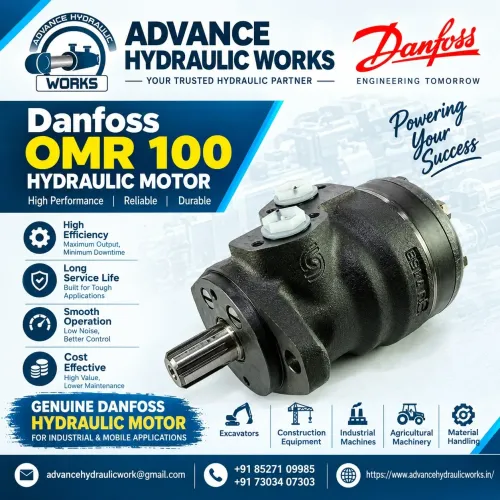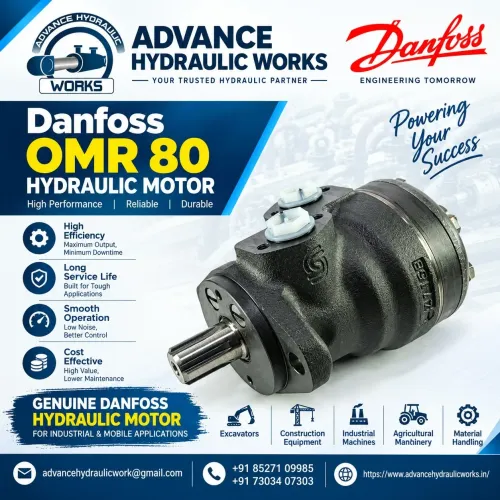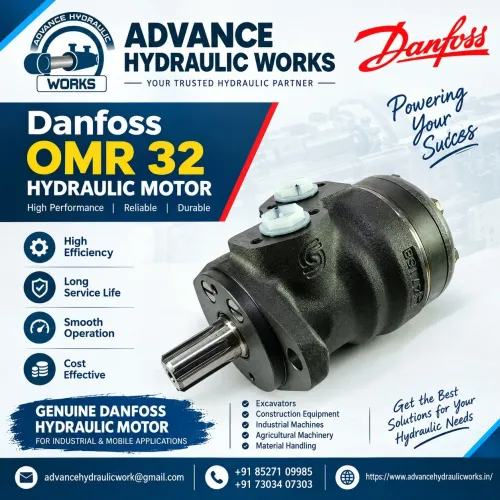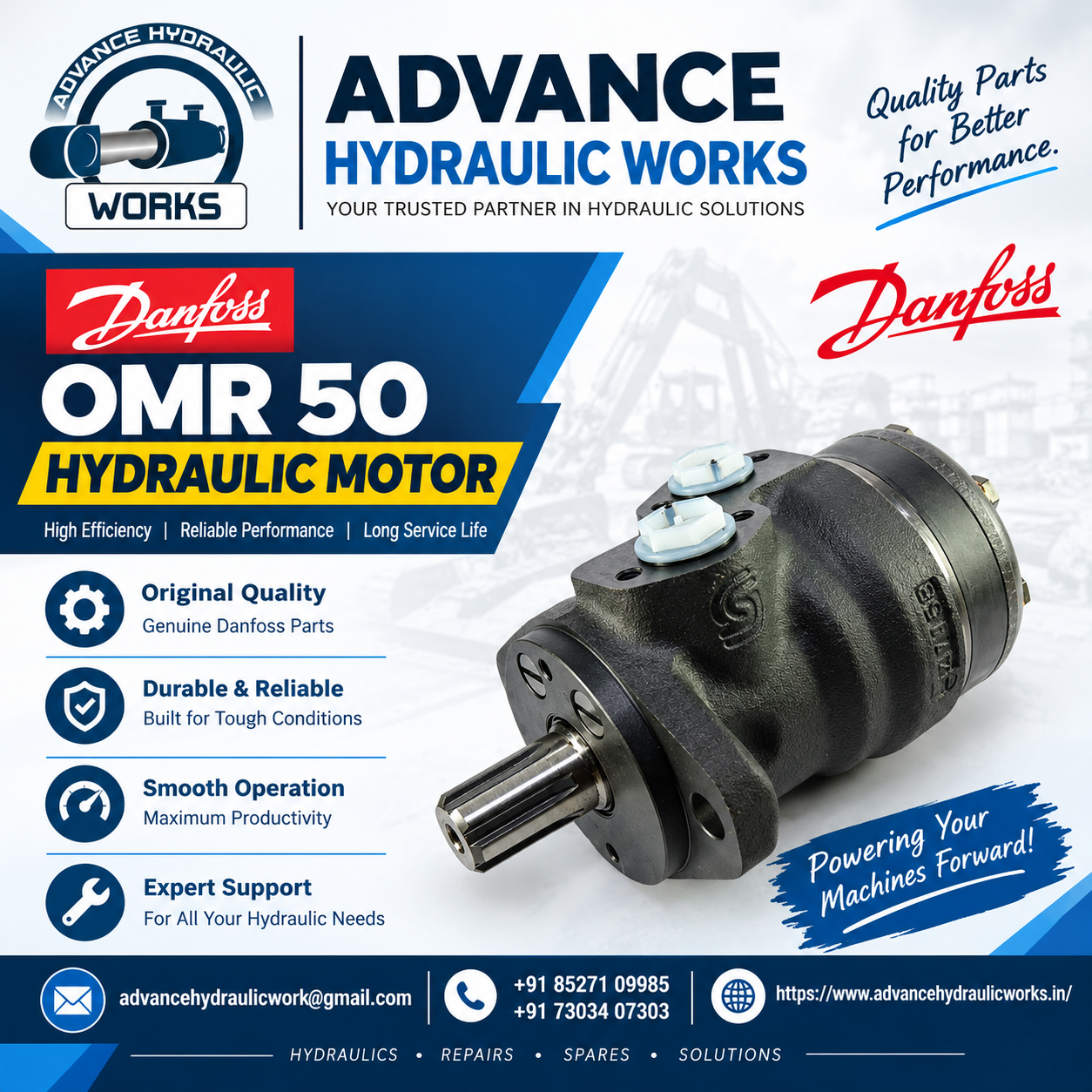
Danfoss OMR 50 repair: when the OMR50 seal kit is enough and when it isn’t
A small orbital motor starts to weep at the shaft, and someone on the floor says, “Fit a seal kit.” Sometimes that’s exactly right. Often it fixes the leak for a few weeks and the motor fails again, because the leak was a symptom of something worse. This guide shows how to tell the difference, which kit number applies and what a proper repair includes. Advance Hydraulic Works works with hydraulic pump and motor repair and supply from Delhi NCR, and this is how we’d go through it with you.
What’s inside the motor?
The motor is a gerotor-type orbital motor. A reseller lists the common version, 151-0410, as a 50 cm³ motor with a straight shaft and no drain port. Its datasheet figures are 51.6 cm³ displacement, about 775 rpm continuous, 100 N·m and 140 bar.
With no separate drain line, the shaft seal sits close to the motor’s low-pressure side. That means two things show up as shaft leaks: pressure in the return line, and internal wear. Both are worth checking before you buy anything.
Danfoss OMR50 seal kit: which one?
Danfoss publishes a seal kit table by series and shaft. For this motor family it shows kit 151-1277 for series 5 with 25 mm, 1 inch and tapered shafts, kit 151-1166 for the 32 and 35 mm tapered shafts, and kit 151-1286 for series 6 with the high-pressure shaft seal. One distributor describes 151-1286 as a seal kit for OMP series 8, OMR series 6 and the DS and DH series.
The listing for 151-0410 indicates the design wide variation is 6, which factors up to 151-1286. But confirm the design or collection in your individual nameplate, due to the fact a series five motor takes one typical Danfoss OMR50 seal package, and a tapered-shaft model takes a third.
A kit typically holds a dust seal, a shaft seal, O-rings and washers. A distributor lists 151-1286 with one dust seal, one shaft seal, three 75.9 mm O-rings, three 90 mm O-rings and seven washers.
What a seal kit can and can’t fix
A kit covers the soft parts. It fixes:
- A leak at the shaft where the motor still runs at the right speed.
- Weeping at the flange joints.
It won’t fix:
- Slow output under load.
- Hot oil from internal leakage.
- A scored shaft or worn bearings.
- A worn gerotor set or valve parts.
If the motor is weak as well as leaking, the seals aren’t the root cause.
Danfoss OMR 50 repair service: what a proper job includes
Whoever does the work, a good Danfoss OMR 50 repair service should:
- Identify the motor’s design and series from the nameplate.
- Strip it and inspect the gerotor set, valve parts, drive shaft and bearings.
- Measure wear and tell you plainly which parts are worn.
- Replace worn parts and every seal, using the right kit.
- Rebuild in clean conditions.
- Test speed, leakage and pressure before it leaves.
- Give you the test results.
Ask any shop, including Advance Hydraulic Works, to confirm these steps before you accept a quote.
The method: inspect, test, decide
Inspect. Find where the oil is coming from. Check the shaft for scoring and the return line for back pressure.
Test. Run the motor at a known flow and measure its speed.
Decide. Healthy speed means a seal kit may be enough. Low speed means internal wear.
A worked example
At 20 litres per minute, a healthy motor of 51.6 cm³ turns at about 20,000 ÷ 51.6, roughly 388 rpm. Say yours turns at 330 rpm under the same flow. At that speed it passes 330 × 51.6 = 17,028 cc a minute, about 17 litres per minute, so about 3 litres per minute leaks internally. At 100 bar, that’s roughly 100 × 3 ÷ 600, around 0.5 kW going into the oil. That’s about 85% volumetric efficiency, and a new seal kit wouldn’t touch it. If the same motor had turned at 385 rpm with only a shaft leak, the kit would be the right answer. This is illustrative arithmetic, and acceptable limits depend on the data for your exact motor.
Implementation steps
- Photograph the motor, its nameplate and the leak before removal.
- Write down the full part number, the design or series and the shaft type.
- Check return-line pressure and rule out a blocked return.
- Test speed at a known flow if you can.
- Send photos and readings to Advanced Hydraulic Works and ask for an appraisal.
- If the kit is adequate, ask the vendor to match it to your chain in writing.
- If not, ask for a restoration quote with parts, testing, and modifications.
- After restoration, reinstall the motor and run it first taken down and check for leaks and heat.
The usual mistakes are fitting the wrong kit for the series, fitting a kit onto a worn motor and ignoring return-line pressure.
FAQs
Which Danfoss OMR50 seal kit do I need?
For a Layout 6 motor with 151-0410, it is normally packaged as 151-1286. A collection of five motors and tapered-shaft versions take unique kits, so check the nameplate.
What is in a Danfoss OMR50 seal kit?
Typically a dust seal, a shaft seal, O-rings and washers. Check the kit’s parts list against your series.
When is a seal kit not enough for Danfoss OMR 50 repair?
When the motor is slow, hot or weak as well as leaking. That points to internal wear that seals can’t fix.
What does a Danfoss OMR 50 repair service include?
Identifying, disassembling and inspecting the motor, replacing worn parts and seals, cleanly rebuilding and testing. Ask for check results.
Can Advanced Hydraulic Works assist with a seal package or repair?
Send pics, nameplates, and characteristics to Advance Hydraulic Works and often ask for the proper kit or restoration evaluation before handing it over.
Your next step
Photograph the motor, note the symptoms and send everything to Advance Hydraulic Works. You’ll know whether it’s a seal kit or a bigger job before you spend anything.