

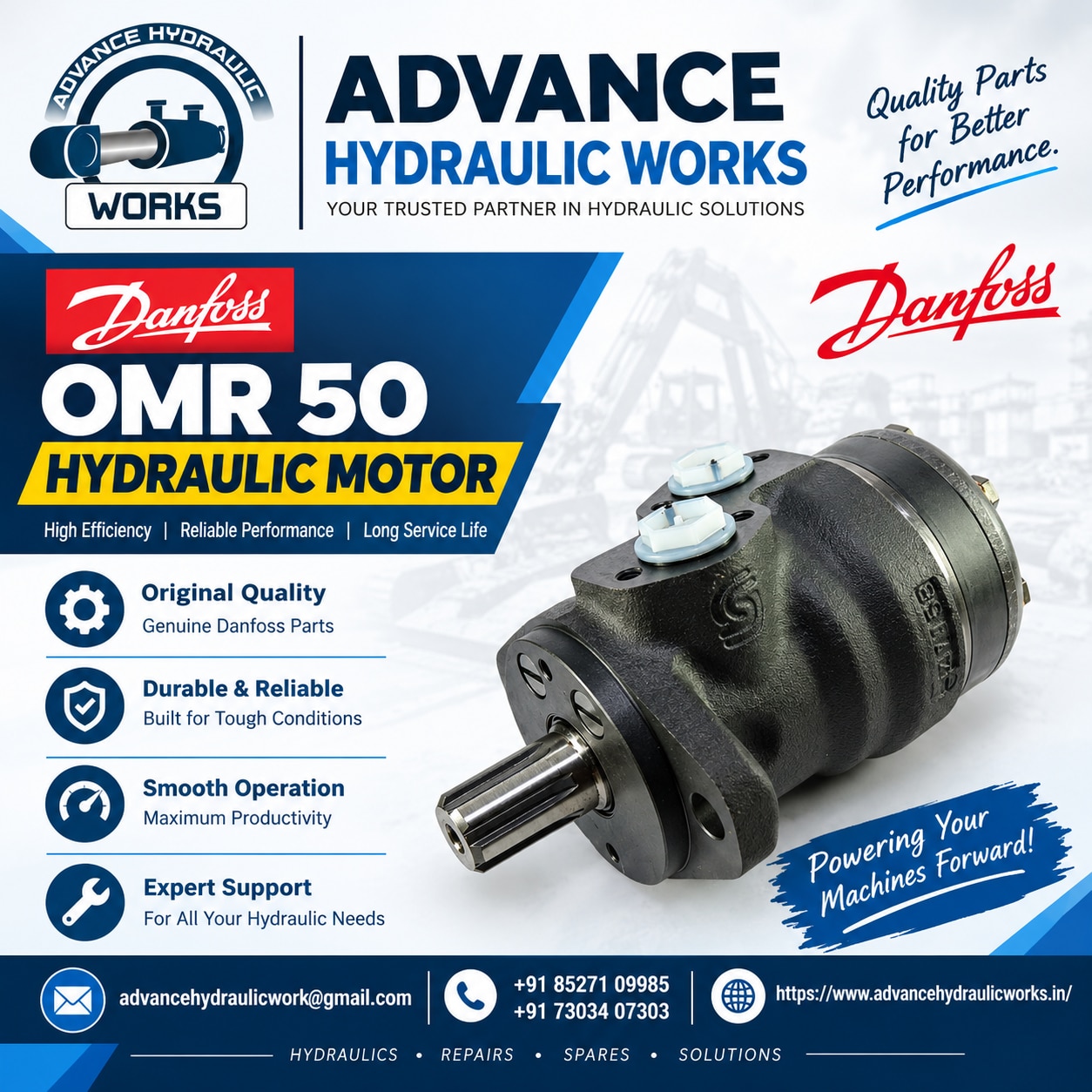
Danfoss OMR 50 and Danfoss OMRX50: what changed and what to check
The Danfoss OMR 50 is one of the most common small orbital motors on sweepers, conveyors, farm machines and construction equipment. It also has a newer sibling, the Danfoss OMRX50, with a different part number for every shaft version. That’s where orders go wrong. This guide gives you the real specs, the differences and a checklist. Advance Hydraulic Works works with hydraulic pump and motor repair and supply from Delhi NCR, and this is how we’d go through it with you.
Danfoss OMR 50 hydraulic motor: the numbers
A reseller datasheet gives the motor’s geometric displacement as 51.6 cm³, with continuous values of 775 rpm, 100 N·m, 7.0 kW, 140 bar pressure drop and 40 litres per minute. Intermittent values are higher: 970 rpm, 130 N·m, 8.5 kW, 175 bar and 50 litres per minute. An Indian distributor’s page adds a peak pressure of 225 bar and a peak torque of 170 N·m.
Another listing gives the weight as 6.64 kg, with a 25 mm shaft and 1/2 inch connections. So the Danfoss OMR 50 hydraulic motor is a compact unit you can handle by hand, but it carries a lot of torque for its size.
Danfoss OMRX50: what’s different
The newer version is made by a different company. A reseller describes the newer range as manufactured by White Drive Motors & Steering (former Danfoss and Sauer-Danfoss), with a displacement of 50 cm³ and a maximum continuous pressure of 200 bar across the range. That’s the range, not this size.
For the size you’re asking about, another reseller’s datasheet shows a displacement of 51.6 cm³, 775 rpm continuous, 100 N·m, 7 kW, a 150 bar pressure drop and 40 litres per minute, with intermittent values of 120 N·m and 175 bar. Compare that with the older figures. The continuous stress point is one hundred and fifty strips per one hundred and forty strips, and the intermittent torque is 130 N•m against one hundred and twenty N•m. Some of that may come from different data sheet editions, so check the current one.
One reseller says the motors from White replace the orbital motors produced by Danfoss, with characteristics and performance unchanged. Broadly that’s right, but “unchanged” isn’t the same as “identical on every line”. So treat the Danfoss OMRX50 as a close relative of the Danfoss OMR 50, not a copy.
Shafts and part numbers
This is where most mix-ups happen. The Danfoss OMRX50 comes in several shaft versions, each with its own number:
- A 25 mm straight shaft with an 8 mm key, listed as 11185537, with a 2-bolt A flange, G1/2 side ports and 51.6 cm³ displacement.
- A splined shaft, listed as 11185584, with six splines and a 1 inch diameter.
- A 1 inch straight shaft, listed as 11186162.
An Indian distributor lists the 25 mm version with an old Danfoss number, 151-0410, and code 11185537. So the old number maps to one shaft version only. Quote the wrong number and you get the wrong shaft.
The method: size, shaft, ports, ratings
Size. Confirm 50 on the nameplate, which means fifty-one.6 cm.
Shaft. Diameter Measurements and Fashion: 25 mm cylindrical, 1 inch instant or splined.
Ports and flange. Check the side ports, the drain and the 2-bolt flange.
Ratings. Compare the pressure and torque with your machine’s needs, using the current data sheet.
A worked example
Say a conveyor drive gets 30 litres per minute. Speed is 30,000 ÷ 51.6, about 581 rpm. At 100 bar, theoretical torque is 51.6 × 100 ÷ 62.8, around 82 N·m, and real torque will be somewhat lower. Both sit inside the continuous limits of 775 rpm and 100 N·m, so the motor is comfortable. Now push the pressure to 150 bar. Theoretical torque is about 123 N·m, which exceeds the continuous 100 N·m rating. The motor would only do that intermittently. That’s the kind of check that saves a motor. This is illustrative arithmetic, not a spec sheet, so use the current data for your exact model.
Implementation steps
- Photograph the old motor’s nameplate, shaft and flange before removal.
- Write down any older Danfoss variations including composite version code and 151-0410.
- Measure shaft diameter and fashion, and observe port sizes.
- Note the flow, pressure and torque the machine needs.
- Send everything to Advance Hydraulic Works and ask what’s available.
- Ask the dealer to state the exact version, shaft model, conditions and warranty in writing.
- Compare the plate and shaft of the added motor with your old one before fitting.
- Flush the lines, fit the motor, run it unloaded first and watch temperature and noise.
The usual mistakes are matching only the size, ignoring the shaft version and running above the continuous ratings.
FAQs
What is the Danfoss OMR 50?
It’s a small orbital motor with 51.6 cm³ displacement, rated at about 775 rpm, 100 N·m and 140 bar continuous. It’s used on sweepers, conveyors and farm machinery.
What is the Danfoss OMRX50?
It’s the newer version of the same size, now made by White Drive Motors & Steering, with similar ratings and several shaft versions.
Is the Danfoss OMR 50 hydraulic motor the same as the Danfoss OMRX50?
Broadly speaking, of course, and a reseller says the overall display is unchanged. However, some datasheets show small differences, so check the state-of-the-art information on your exact model.
Can Advanced Hydraulic Works offer a Danfoss OMR 50 hydraulic motor?
Send nameplate photos, model code, running pressure to Advance Hydraulic Works and inquire about availability, supply and assurance earlier than you hand over.
How do I pick the right shaft version for a Danfoss OMRX50?
Measure your old shaft’s diameter and style, and match it to the part number. The 25 mm straight, 1 inch straight and splined versions all have different numbers.
Your next step
Photograph the nameplate, measure the shaft and send everything to Advance Hydraulic Works. You’ll know exactly which version you need before you spend anything.
