

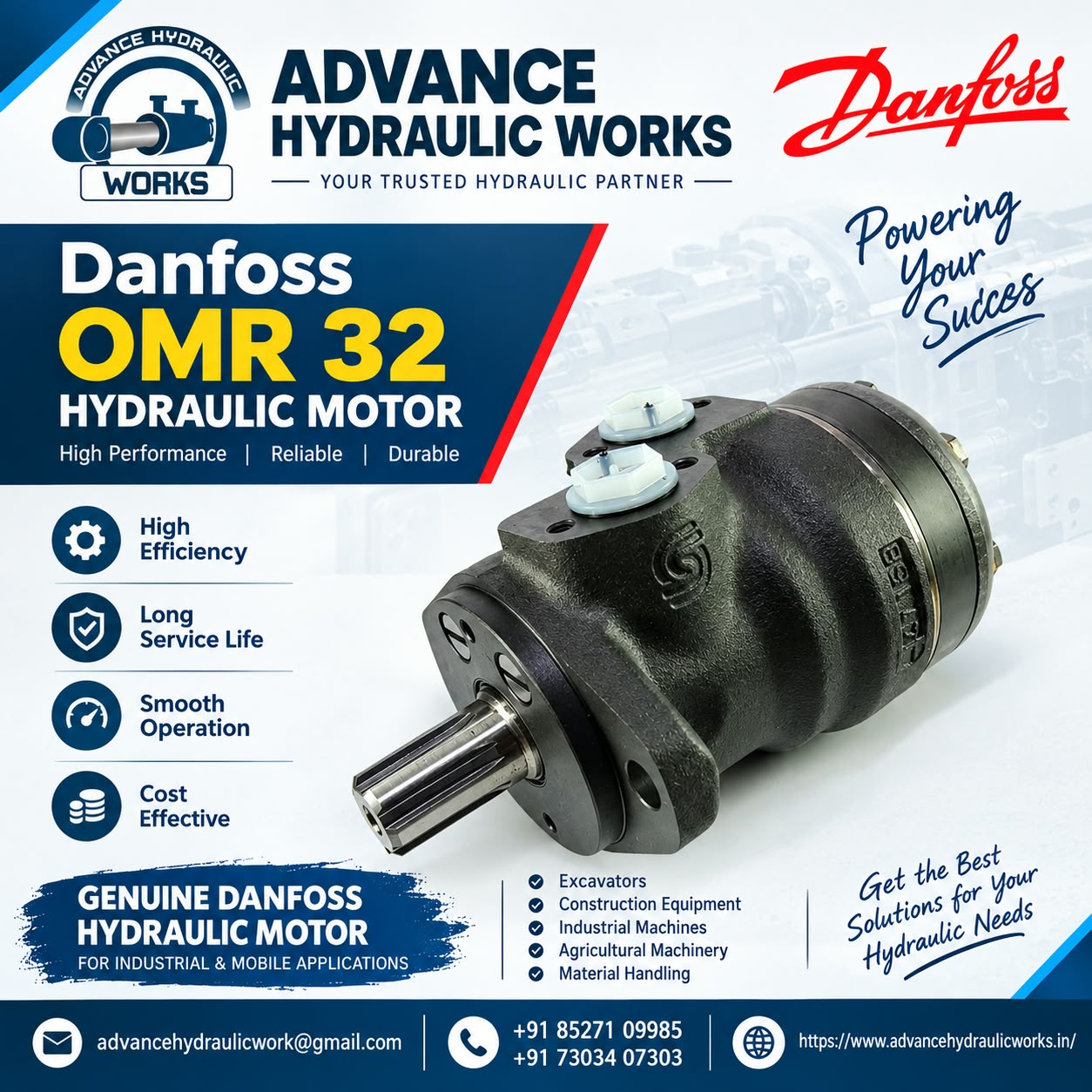
Danfoss OMR 32: which 32cc orbital motor do you actually mean?
Here’s something worth knowing before you order. I checked Danfoss’s technical catalogues and several reseller catalogues, and I couldn’t find a standard motor called the Danfoss OMR 32. The smallest standard OMR in those catalogues is the 50. That doesn’t mean your motor doesn’t exist. It means the name probably points to a neighbour in the family. This guide shows how to work out which one, so you order the right Danfoss OMR 32 motor. Advance Hydraulic Works works with hydraulic pump and motor repair and supply from Delhi NCR, and this is how we’d go through it with you.
What the catalogues show
Danfoss’s technical information covers the OMP, OMR and OMH orbital motors together. The OMR sizes in that document run from 50 to 375, with geometric displacements of 51.6 cm³ up to 372.6 cm³. A reseller datasheet confirms the OMR 50 at 51.6 cm³, 775 rpm continuous, 100 N·m and 140 bar, as the smallest in its table.
The 32 shows up somewhere else. The same family’s tables list an OMP 32 in the dimension tables. And a newer catalogue for the X versions lists an OMR X range with a displacement code of 36, not 32.
Danfoss OMR 32 motor: three likely meanings
So when someone says Danfoss OMR 32 motor, they probably mean one of these:
- OMP 32. A 32 cc motor in the same medium-sized family, easily confused because the OMP and OMR look alike and share mounting.
- OMR 36. A 36 cc size in the X range, close enough to be called “32” by mistake or by habit.
- OMR 50. The smallest standard OMR, which a seller might offer as “the nearest”.
I can’t tell which from the name alone, and neither can you. Only the nameplate settles it.
Danfoss OMR 32 hydraulic motor: why the difference matters
The size of an orbital motor determines its speed and torque. In the same oil tank, the smaller motor spins faster and delivers less torque. Take 20 litres per minute. A 32 cc motor turns at about 20,000 ÷ 32 = 625 rpm. A 36 cc motor turns at about 556 rpm. The OMR 50, at 51.6 cc, turns at about 388 rpm.
Torque goes the other way. At 100 bar, theoretical torque is roughly pressure × displacement ÷ 62.8. That’s about 51 N·m for 32 cc, 57 N·m for 36 cc and 82 N·m for the 51.6 cc motor. Real torque is lower once losses are counted. So swapping one for another adjusts how the gadget behaves. This is illustrative math, no longer a spec sheet, so check your motor’s actual stats.
Why this causes wrong orders
A seller who sees “OMR 32” in an enquiry has three options: guess, ask or offer the nearest. Guessing gets you a motor that bolts on but runs at the wrong speed. Offering the nearest is fine if they tell you. And a seller who just says “yes, we have it” may be matching the name, not the motor.
The method: name, plate, size, shaft
Name. Write down exactly what’s printed on the motor, not what people call it.
Plate. Photograph the nameplate and observe the model code and displacement.
Size and shaft. Measure the shaft, flange, and port, and check for desired speed and torque.
Confirm. Ask the seller to state the exact model and displacement in writing.
A worked example
Say a conveyor needs about 600 rpm at 20 litres per minute. A 32 cc motor gives about 625 rpm, which fits. An OMR 50 at 388 rpm would run the belt around 38% slower, and the machine would feel wrong. Now suppose a seller offers the OMR 50 as “the same as OMR 32”. You can see the problem from the arithmetic alone. If you’d checked the plate first, you’d know whether your original was a 32cc OMP, a 36cc or something else. The nameplate pays for itself. This is an illustrative case, not a quote.
Implementation steps
- Take photographs of the old motor’s nameplate, shaft, and flange before removal.
- Write down the exact version code and displacement.
- Note the flow, pressure and speed the machine needs.
- Send everything to Advance Hydraulic Works and ask what’s available.
- Ask the seller to provide the exact model, displacement, position and assurance country in writing.
- Check shaft, flange and ports against the old motor.
- Compare the delivered motor’s plate with your order before fitting.
- Flush the lines, fit the motor, run it unloaded first and watch temperature and noise.
The usual mistakes are ordering by nickname, accepting “the nearest size” without saying so and skipping the plate check.
FAQs
Is there a Danfoss OMR 32?
I couldn’t find a standard Danfoss OMR 32 in Danfoss’s catalogues. The smallest standard OMR is the 50, and the 32 appears in the OMP range.
What is a Danfoss OMR 32 motor?
Most likely a nickname for a 32cc OMP, a 36cc OMR X or the OMR 50. Read the model code and displacement from the nameplate to be sure.
What is the difference between OMP and OMR?
They’re both orbital motors in the same Danfoss family, with different sizes and construction. Check the model code, because they can look alike.
Can Advanced Hydraulic Works deliver a Danfoss OMR 32 hydraulic motor?
Send nameplate drawings, model code, working stresses to Advance Hydraulic Works and ask about availability, supplies and assurance before handover.
What happens if I fit the wrong size?
The machine runs at incorrect speed and torque. A smaller motor runs faster with much less torque, a larger one runs slower with excess.
Your next step
Photograph the nameplate, write down the exact model code and send everything to Advance Hydraulic Works. You’ll know which motor you really have before you spend anything.
