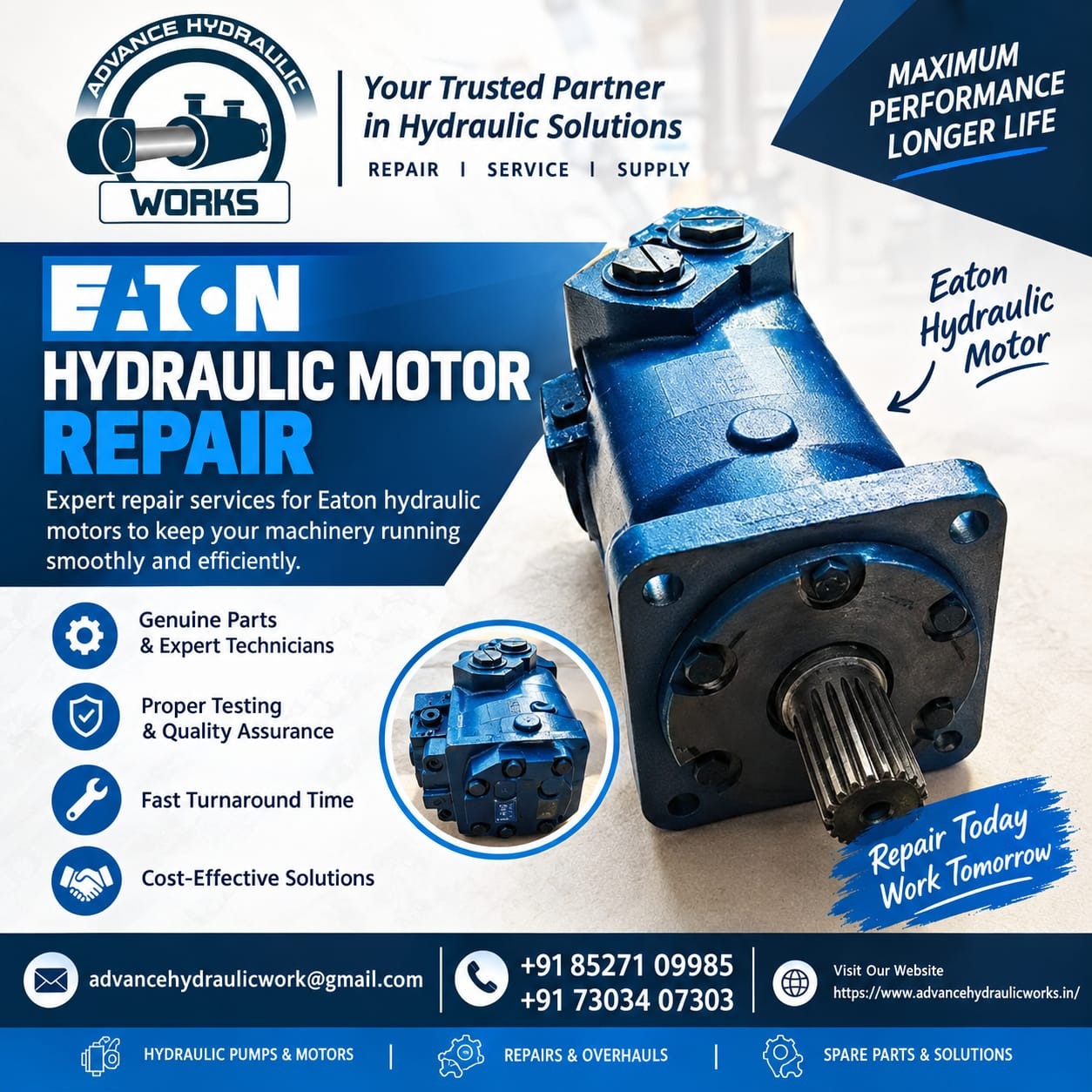
Eaton hydraulic motor repair cost: what determines the price
Ask three repair shops what an Eaton hydraulic motor repair costs and
you'll likely get three different numbers before any of them have even seen the
motor. That's not evasiveness — repair cost genuinely can't be pinned down
without a teardown, because the price is built from what's actually wrong, not
from a flat rate per motor type.
Why "how much does it cost" doesn't have one answer
A motor that needs a seal kit and a bearing is a fundamentally different
job from one with a scored gear set or a damaged shaft. Quoting a single number
for "Eaton motor repair" the way a car service quotes an oil change would
mean either overcharging most customers or undercharging the ones with serious
internal damage. A reasonable shop inspects first and quotes second.
The four factors that actually move an Eaton motor repair quote
Extent of
internal damage
This is the single biggest variable. The
surface placed on the seals and bearings is a fix for low duty. Scoring, crack
housing, or shaft damage at the gerotor/geroler tool set will push activity
towards a full rebuild, which is more costly in components and labor.
Motor
family and part availability
A Char-Lynn LSHT orbital motor and an Eaton vane motor don't share
parts, and neither does every displacement variant within a series. Common,
widely-stocked models are quicker and cheaper to source parts for than older or
less common configurations, where a shop may need to special-order components.
OEM parts
versus quality equivalents
Genuine Eaton parts typically cost more than quality aftermarket
equivalents, but they also carry the reliability track record the OEM design
was tested against. Ask your repair shop directly which parts they're quoting —
a shop that can't answer clearly is worth being cautious about.
Labor and
bench testing time
Teardown, inspection, reassembly, and post-repair bench testing all add
labor hours. A motor that tests clean on the first pass costs less in labor
than one that needs rework after an initial test flags a problem.
What a proper repair quote should break down
A quote worth trusting itemizes rather than bundles. At minimum, it
should separate parts cost from labor cost, specify which parts are OEM versus
equivalent, and state whether bench testing is included before the motor ships
back. If a quote is a single lump figure with no breakdown, ask for one before
approving it — not because the shop is necessarily wrong, but because you can't
sanity-check a number you can't see the components of.
When repair cost stops making sense compared to replacement
Repair usually wins on cost for motors with contained damage — seals,
bearings, minor wear. When the housing or shaft is damaged
beyond tolerance, or when the motor is of sufficient vintage that sourcing
components takes longer than sourcing a substitute unit stops to experience If
a store inspection loses many important additives straight away, it's worth
asking for repair-update cost reversals.
FAQ section
Why won't a repair shop give me a flat price over the phone?
Because the cost depends on what a teardown finds — seal wear costs far less to
fix than gear set scoring or shaft damage, and no shop can know which one
applies without inspecting the motor first.
Are OEM parts always worth the extra cost in a repair?
Not automatically, but they carry the reliability data the original design was
tested against. Ask your repair provider which parts they're using and why,
rather than assuming either OEM or equivalent parts are the default right
answer.
What should an Eaton motor repair quote include?
A breakdown separating parts from labor, a note on whether parts are OEM or
equivalent, and confirmation that the motor will be bench tested before it's
returned to you.
Is it cheaper to repair a Char-Lynn motor than an Eaton vane motor?
Not inherently — cost depends on the extent of damage and part availability for
that specific model, not the motor family alone.
At what point should I replace instead of repair?
When damage extends to major structural components like the housing or shaft,
or when the motor model is old enough that sourcing repair parts takes
noticeably longer than sourcing a replacement.
Does bench testing add much to the repair cost?
It adds some labor time, but it's what confirms the motor will actually perform
under real load rather than just looking fine on a workbench — skipping it to
save cost usually costs more later if the motor fails again quickly.