

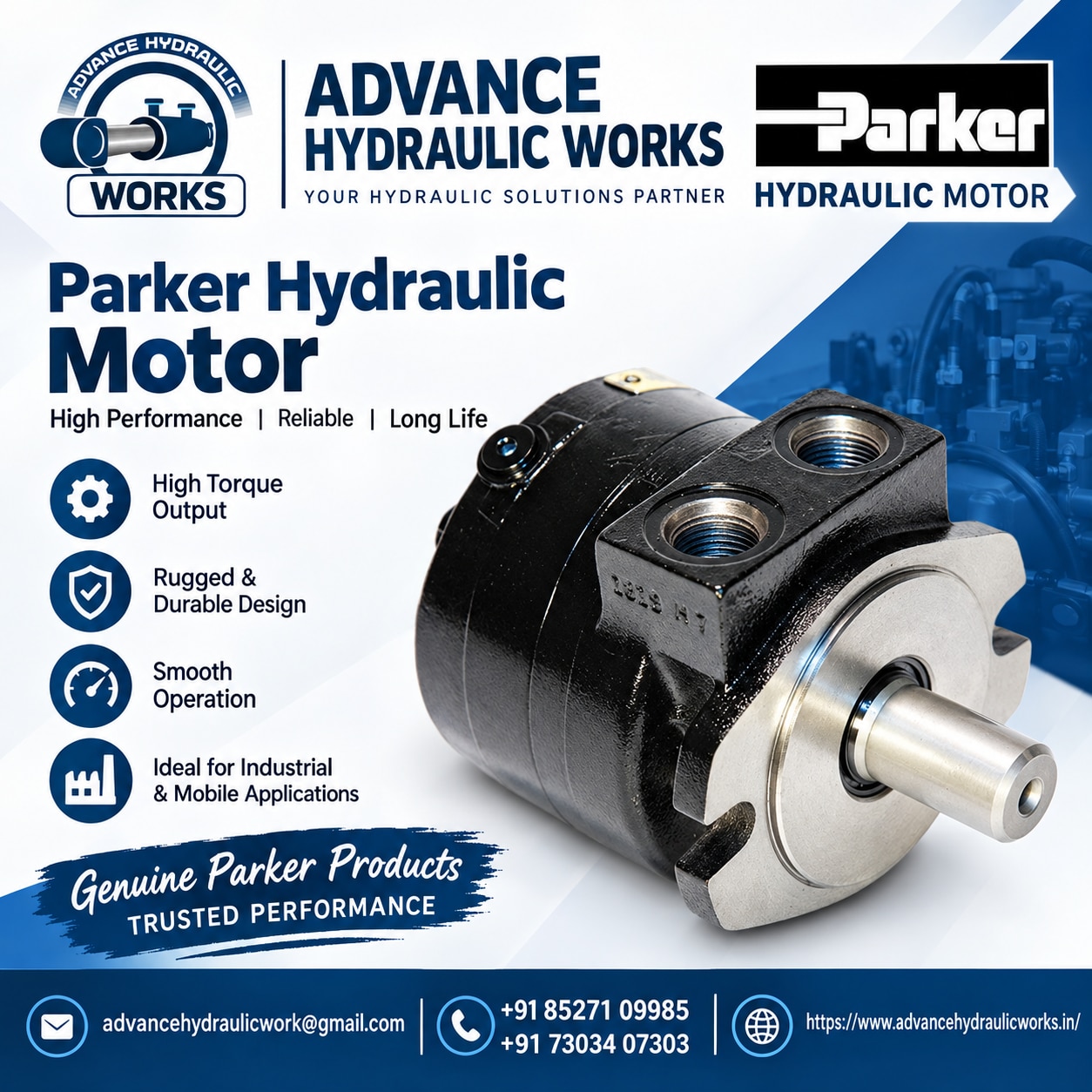
Parker hydraulic motor:
gerotor, orbital, and choosing the right Torqmotor series:-
If you've searched both "Parker gerotor motor" and
"Parker orbital hydraulic motor" wondering whether they're different
products, they're not. Getting that cleared up first makes the actual decision
— which Parker motor series fits your application — a lot easier to think
through.
"Gerotor" and
"orbital" describe the same motor design:-
Parker markets its low-speed, high-torque hydraulic motors under the
Torqmotor™ name, and these orbital-style gerotor motors apply the gerotor
principle to deliver low-speed, high-torque performance. In plain terms:
"gerotor" refers to the internal gear mechanism, and
"orbital" refers to how that mechanism moves — they're describing the
same motor from two different angles, not two separate product lines. Any
Parker motor you'll find under either search term belongs to the same Torqmotor
family.
Parker's Torqmotor series
by duty class:-
Where it actually gets useful is understanding that Parker Hydraulic Motor doesn't sell
one Torqmotor — it sells a range of series built for different duty levels, and
picking the wrong one is a more common mistake than picking the wrong brand.
#Light duty — TE series:-
The Parker TE Series Torqmotor is built for light-duty applications such
as vehicle propulsion, augers, chain drives, winches, and boom rotation,
available across 15 displacements from 36 cc/rev to 392 cc/rev, with
intermittent pressures up to 190 bar and torques to 648 Nm. This is the series
most suited to smaller, lighter-duty drives rather than continuous heavy loads.
#Medium duty — TF series:-
The Parker TF Series is a durable low-speed, high-torque orbital motor
ideal for medium-duty applications, with superior side-load capacity, handling
intermittent pressures to 280 bar and torques to 920 Nm across 12 displacements
from 81 cc/rev to 477 cc/rev. A TF-series clutch variant is also available for
applications needing a freewheeling output shaft during part of the duty cycle.
#Heavy duty — TG and TGK
series:-
The TG series is built for demanding industrial and mobile applications,
with continuous working pressure ratings around 210 bar depending on the
specific model. The TGK series steps up further — Parker's TGK series provides
up to 66% greater torque capacity for superior power density than standard TG
units, aimed at higher-horsepower applications like heavier vehicle propulsion,
augers, and boom rotation where a smaller footprint still needs to deliver
serious torque.
What actually determines
the right series for your application:-
Rather than starting from a brand name, the practical starting point is
your application's actual pressure, torque, and duty-cycle requirements —
continuous versus intermittent load matters here, since a series rated for
intermittent peaks isn't necessarily suited to sustained heavy use. Once you
know the pressure and torque your application demands, matching that to a
series (light, medium, or heavy duty) narrows the decision considerably before
you even get to a specific displacement or part number.
Sourcing or repairing a
Parker hydraulic motor:-
Once you've identified the right series and displacement — ideally
confirmed off an existing motor's nameplate rather than a general description —
sourcing or rebuilding becomes a much more precise conversation with a
supplier. Advance Hydraulic Works sources and repairs Parker hydraulic motors
across the gerotor/orbital range, and can help confirm which series and
displacement your application actually needs before quoting.
FAQ section
1. Is a Parker gerotor motor the same as a Parker orbital motor?
Yes. Both terms describe the same Torqmotor product family — gerotor refers to
the internal mechanism, orbital refers to how it operates. They aren't separate
product lines.
2. What's the difference between the TE, TF, and TG/TGK series?
They're built for different duty classes — TE for light duty, TF for medium
duty with higher pressure and torque capacity, and TG/TGK for heavy-duty,
higher-power applications
3. How do I know which series my existing motor is?
Check the nameplate for the series designation (TE, TF, TG, TGK, or similar)
and displacement code, rather than assuming from the application alone.
4. Can a TE-series motor be replaced with a TF-series motor?
Not automatically. The two are built for different duty and pressure ranges, so
a like-for-like series and displacement match is the safer approach unless your
supplier confirms otherwise.
5. What information should I give a supplier before ordering a
replacement?
The series designation and displacement from the nameplate if available, or
your application's required torque, pressure, and duty cycle if the nameplate
isn't legible.
6. Can Parker hydraulic motors be repaired instead of replaced?
Often, yes, provided the housing and shaft are in good condition and a matching
rebuild kit is available for that specific series and displacement.
