

 Hydraulic motor VS. hydraulic pump: what’s the Real
Difference?
Hydraulic motor VS. hydraulic pump: what’s the Real
Difference?
If you've
ever stared at two identical-looking cylinders on a machine and wondered which
one is actually pushing the oil and which one is taking the power, you are
definitely not the only one. Honestly, figuring out the difference can trip up
even experienced maintenance techs. Take a peek inside, and you will see they share a lot of the same DNA—things like gears, vanes, or pistons—and both rely
heavily on pressurised oil to do their thing. From the outside, they can easily
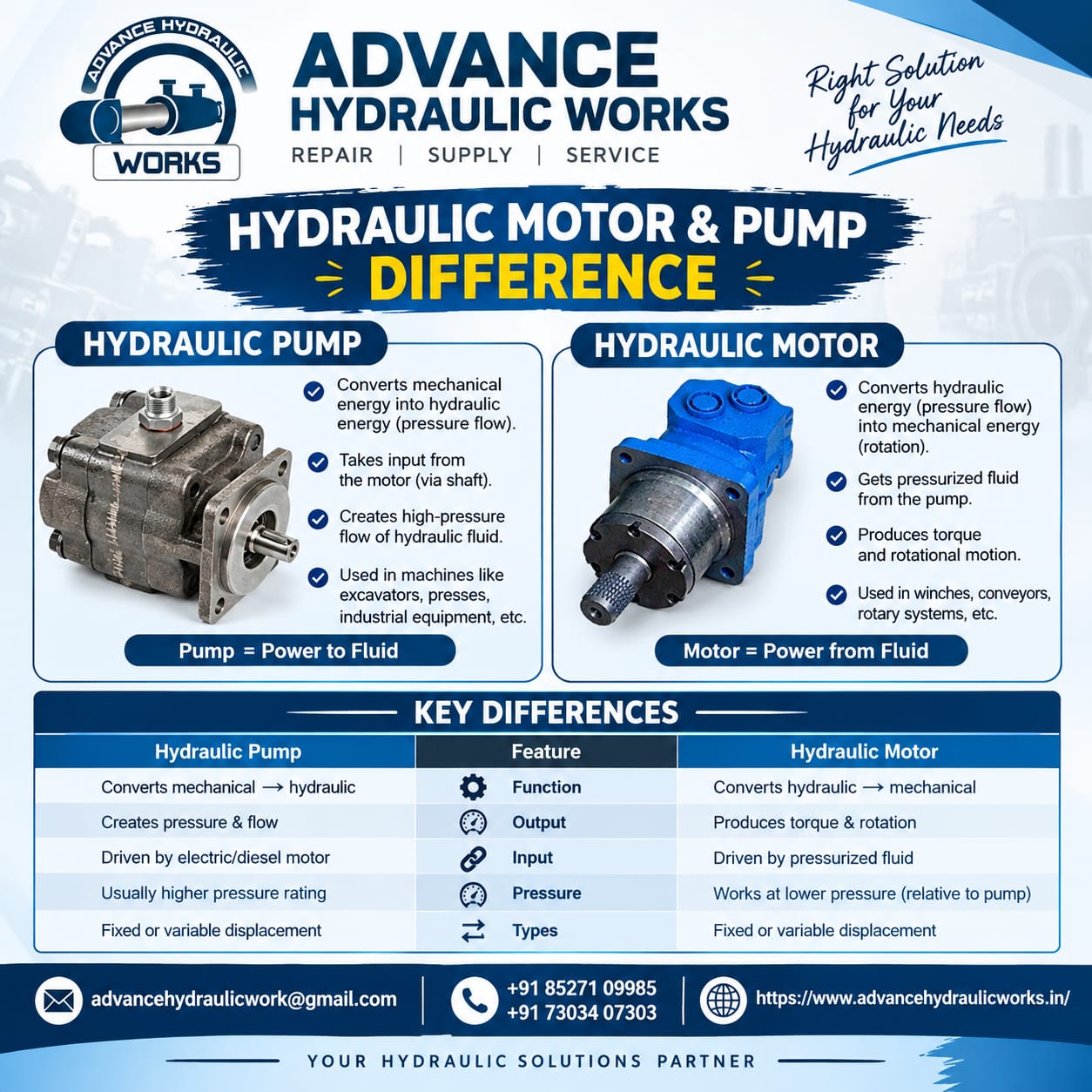
pass twins, but the real magic comes down to energy flow: a pump takes
mechanical muscle and turns it into hydraulic movement, while a motor does the
exact opposite by turning that fluid flow right back into mechanical muscle.
Hydraulic
motor vs hydraulic pump: the main mechanical difference
A pump
uses mechanical power from an engine or motor and turns it into hydraulic flow
and pressure. A hydraulic motor works in the opposite way—it uses pressurised
fluid to produce mechanical rotation. In simple terms, the components may be
similar, but their functions are reversed
At
Advance Hydraulic Works, we get asked about this almost weekly, usually by
someone troubleshooting why a unit isn't spinning a load the way it used to.
Here's the practical method we use to sort it out:
- Check the drive direction. If the shaft is being
turned by an external prime mover (electric motor, diesel engine), you're
looking at a pump. If the shaft is the thing doing the work — turning a
wheel, an auger, a winch — it's a motor.
- Look at the case drain and
shaft seal setup. Motors are generally designed to handle
rotation and load in both directions. They also commonly use a case-drain
line to return fluid to the tank, while pumps usually don’t require the
same setup.
- Look for a low- speed, high-
torque design. Orbital
and gerotor motors are commonly used where strong rotation is needed at
lower speeds, such as in excavator swing drives
- Trace the circuit. Follow the pressure line
from the reservoir. The first component after the prime mover is the pump.
The component doing mechanical work downstream is the motor.
Real-world example
Think
about how a forklift relies on a hydraulic pump to generate the pressure needed
to lift the mast, or how a skid-steer’s hydrostatic drive pushes pressurised
oil straight to the wheel motors to get rolling. Even though the fluid type and
pressure limits might look identical, what each part actually gets done is totally night and day.
How to identify a pump vs motor on your Equipment
A unit
coming into our shop for inspection isn’t identified by its label alone, since
labels can be replaced or worn out. We check the mounting position, shaft
connection, and internal displacement mechanism. A pump mounted directly to an
engine bell housing is usually a pump, while a unit connected to a wheel hub or
swing gear is typically a motor. At Advance Hydraulic Works, we make this identification part of our standard repair
inspection. Identifying the unit correctly helps us choose the right rebuild kit
and avoid unnecessary delays.
FAQs
1.
Hydraulic motor vs hydraulic pump: what's the real difference?
Basically, a pump takes mechanical spin and turns it into pressurised fluid
movement, whereas a motor does the exact opposite by switching that fluid
pressure right back into mechanical rotation. That flip in energy flow is
really what sets them apart.
2. Is a
hydraulic motor the same as a hydraulic pump?
No. They can share the same internal design family — gear, vane, or piston —
but they're built and configured for opposite jobs in the circuit.
3. How do
I identify pump vs motor on my equipment?
Follow the lines straight from the reservoir: whatever component is being spun
by an external engine or electric motor is your pump. On the flip side, the
part driving the wheel, drum, or gear to get actual work done is definitely the
motor. If the labels are missing or unreadable, the crew at Advance hydraulic
works canalways drop by to check it out on site
