

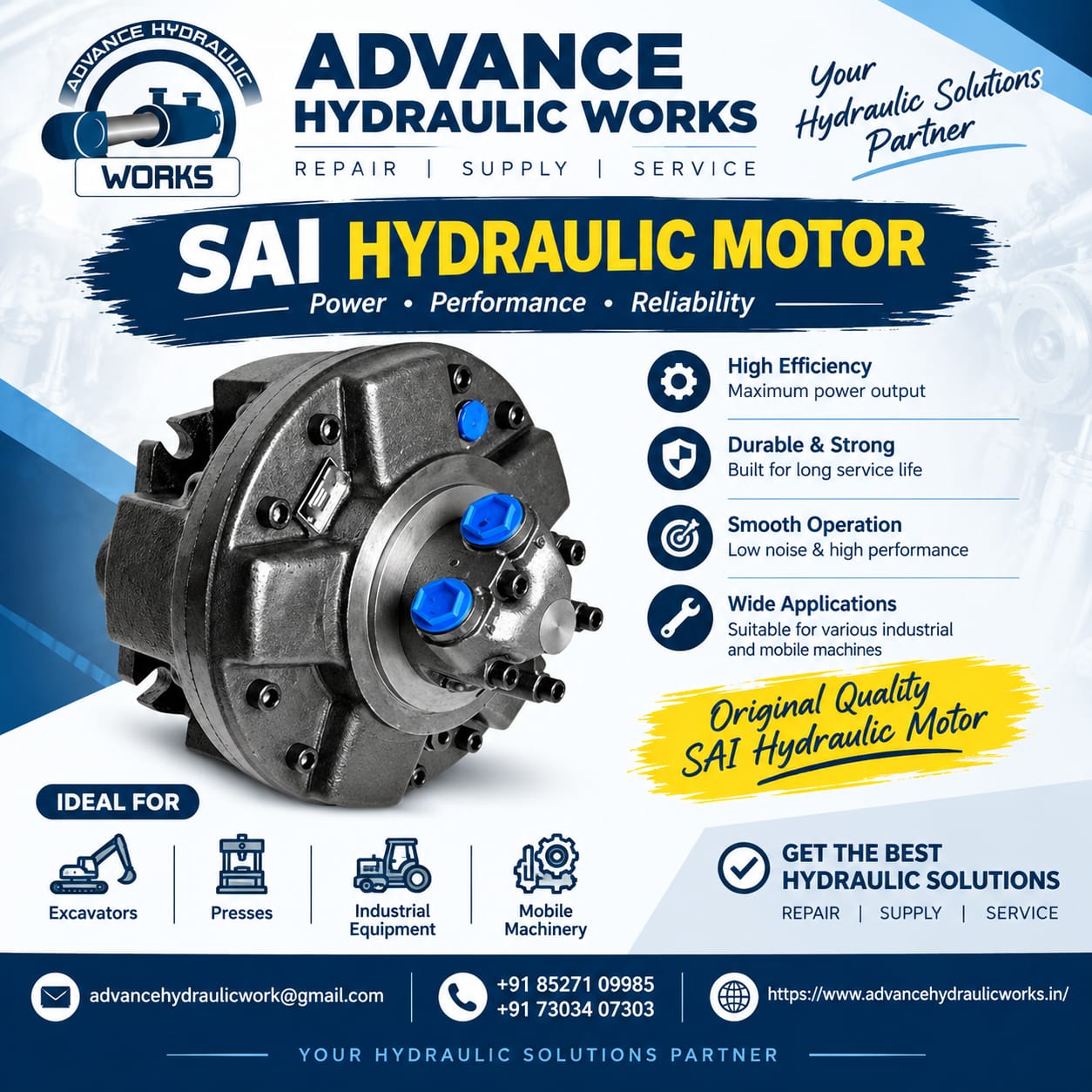
SAI Hydraulic Motor: What to Know Before You Buy or Repair One
If a SAI hydraulic motor on your equipment has started losing power, running
hot, or leaking, the fix usually comes down to one of three things: wear inside
the motor, contaminated oil, or a mismatch between the motor and the load it's
driving. Getting this right saves you from paying for a repair that doesn't
actually solve the problem.
Why SAI motors show up so often in Indian industrial setups
SAI hydraulic motors are common in orbital and gerotor-style applications —
augers, winches, conveyor drives, small mixers, and similar low-speed,
high-torque jobs. They're built to handle steady loads rather than sudden
pressure spikes, which is exactly why problems tend to surface gradually. A
motor that was running fine six months ago starts slipping under load, or takes
longer to reach full speed, long before it fails outright.
What actually causes most SAI Hydraulic problems
Three things account for the bulk of the service calls we see:
Contaminated oil scores the internal gerotor set, and once that happens, no
amount of seal replacement fixes the slippage. Worn shaft seals let oil past
the case drain, showing up as external leaks near the motor housing. And
oversized or undersized motors — installed because someone matched flow rate
but not torque requirement — wear out fast no matter how well they're
maintained.
A proper SAI Hydraulic Service starts with checking case drain flow before
opening anything up. High case drain flow at low RPM almost always points to
internal wear rather than a seal problem, and it tells a technician where to
actually look instead of guessing.
How we approach repair and sourcing
At Advance Hydraulic Works, motors come in for inspection before any parts
get ordered. We check displacement against the equipment's actual duty cycle,
not just the nameplate spec, because a lot of motors get replaced with the
wrong size the first time around. For genuine SAI Hydraulic parts, we source
directly rather than through resellers, which keeps both cost and turnaround
predictable. Advance Hydraulic Works handles both repair and supply, so if a
motor's beyond economical repair, replacement doesn't mean starting the
sourcing process from scratch. Since Advance Hydraulic Works works pan-India on
pickup and dispatch, this isn't limited to walk-in service either.
FAQs
How do I choose the right hydraulic motor for my equipment?
When choosing the appropriate hydraulic motor in your setup, an in-depth
presence of what your system truly requires in terms of torque and speed. Just
don't blindly agree with the top stress rating of the pump. If you go with a
motor that is really too small, it puts up excellent fast. On the turn side,
installing an outsized motor is just a waste of hydropower, and costs you more
in the end. If you feel stuck on the exact size, just chat with the supplier,
provide them with your equipment weight and RPM information, and double-check
the specifications before making your final call.
What are the main types of hydraulic motors?
Gear motors are simple and cheap but less efficient. Vane motors sit in the
middle on cost and performance. Piston motors — axial or radial — handle the
highest pressures and torque, and orbital/gerotor motors, which is where SAI
models mostly fall, are built for low-speed, high-torque jobs like augers and
winches.
Why is my hydraulic motor not working properly?
A hydraulic motor can start performing poorly for several reasons. Contaminated
oil may damage its internal parts, while worn seals can lead to internal
leakage. In some cases, the motor may simply not have been sized correctly for
the equipment’s load. Checking the case-drain flow can help identify whether
internal leakage is contributing to the problem.
