New Delhi
08042756439
+918527109985
HYDRAULIC PUMP by yuken

Yuken PVR 150 Series

INR 21000
In stock•cod not available
Phone Number

08042756439

Please keep 0 before dialling the number.

Mon-Thu: 10 AM - 2 PM • Fri: 3 PM - 7AM

Other Website Visit our other website
Address Shed no 89, Wazirpur Industrial Area

New Delhi, India, 110052

Description

Yuken Vane Pump PVR150-FF-90-R-AA-3480: When a Yuken PVR150-FF-90-R-AA-3480 vane pump stops performing, the pressure is immediate. A hydraulic press that won't hold tonnage, an injection moulding machine cycling slow, or a power pack that howls under load — these aren't abstract problems. They translate to stopped production, missed dispatch deadlines, and maintenance teams under pressure to find a fix fast. What the PVR150-FF-90-R-AA-3480 Model Code Actually Tells You “PVR150“ identifies the series: a vane pump with a nominal displacement variation of 60 to one hundred and seventy cm3/rev . It's part of Yuken's line of merchant vane pumps, widely used in hydraulic presses, injection molding machines, and energy packs where easy, medium to high tension wafts are required. Key Performance Parameters The PVR150-90 variant PVR150-ninety variation ninety cm3/rev. At 1500 rpm, that translates to a theoretical go with a flow of about one hundred and thirty-five L/min. At 1,800 rpm, the waft increases to about 162 L/min. The actual waft brought in may be lower due to volume efficiency losses — usually within the ninety-five–ninety-five% variation for a healthy pump. The maximum pressure of the PVR150 collection is rated at one hundred and seventy-five kgf/cm2 (approximately 2,490 psi) in non-stop operation, with good intermittent performance The pump is designed for oil viscosity at a variety of 20 cSt at operating temperature, roughly ISO VG 32 hydraulic oil at 50°C It is consistent. What the “3480“ Design Standard Means for Sourcing The 3480 designation is not just a part number suffix. It identifies a specific design generation with known spare part compatibility. The seal kit for this design standard is KS-PVR150-3480 . The cartridge kit is CPVR150-90-R-33 . If you order a spare part for a pump with a different design number — say 3180 — the parts may not interchange. This is a common source of ordering errors. Always match the design standard at the end of the model code when sourcing spares. Why PVR150 Series Vane Pumps Fail: Vane pumps fail in predictable ways. The specific failure mode often tells you something about the system condition — not just the pump. Understanding this distinction is the difference between a repair that lasts and one that fails again in six months. Contamination and Fluid Degradation — Industry data consistently points to contamination as the dominant cause of hydraulic pump failure. Parker's service documentation states that 80% of vane pump failures are linked to fluid contamination incidents . MRO Magazine echoes this: more than 80% of vane pump and motor failures trace back to dirty hydraulic fluid . For the PVR150, contamination manifests in specific ways. The vanes ride in slots in the rotor. Debris that enters the slot clearance can cause vanes to stick — either stuck inward (no flow) or stuck outward (excessive wear on the cam ring). Fine Fine particles smaller than the filtration degree circulate indefinitely, acting as an abrasive lapping compound inside the pump. The PVR150-Specific Weak Point: The port plate is the flat surface that seals against the rotor and vanes, directing flow from the pumping chambers to the outlet port. In the PVR150, the port plate is subject to erosion when fluid viscosity is too low — typically from overheating . Tests referenced in Parker's service manual show that a reservoir temperature of 50°C can correspond to local temperatures inside the pump of up to 130°C . At one hundred and thirty°C, ISO VG 32 oil falls well below its designed viscosity variation. The lubrication film thins, the metal-to-steel touch increases, and the port plate wears out. What to Check Before Ordering a Replacement or Spare: Ordering the wrong part for a PVR150 is an expensive way to learn that model codes matter. Two checks prevent most ordering errors. Verify the Model Code — Every Character Matters The PVR150 series includes displacement options from 60 to 170 cm³/rev, foot and flange mounting, clockwise and counter-clockwise rotation, and multiple port position configurations. A pump that looks identical externally may have a different internal displacement or rotation direction. The nameplate on your existing pump is the authority.If the nameplate is missing or illegible, it is necessary to have a set up drawing or an authentic purchase order or model code. If neither is available, the hydraulic workshop can get a sense of the pump using regular measurements of mounting flange dimensions and shaft configuration, but this is slower and much less dependent than the original code. FAQ Section Q: What does the “3480“ in PVR150-FF-90-R-AA-3480 mean? A: It's the design standard. The “34“ indicates the design number, and “80“ is the design standard reference. Yuken notes that design numbers may change from 30 to 39, but installation dimensions remain consistent across these design variations . For spare parts, the design standard matters: seal kit KS-PVR150.

Keywords

Other Products

view all

69d5000bb619a09c411f1eb9 Card 2

product image
HYDRAULIC PUMP

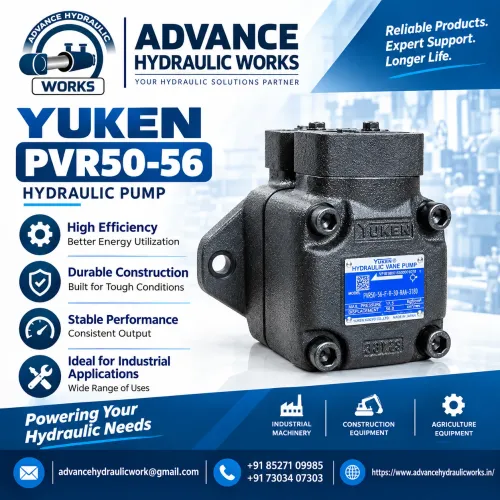
Yuken PVR50-56 Vane Pump: Price vs. Lead Time When the Line Is Down:- A nameplate reading PVR50-F-F-56-RAA-3180 usually shows up on equipment running a heavier, more continuous duty cycle — which means the cost of waiting on a replacement often outweighs a small saving on price. Reading PVR50-F-F-56-RAA-3180:- PVR marks the series — a variable displacement, pressure-compensated vane pump. 50 is the frame size. F-F specifies shaft and port configuration. RAA covers rotation and mounting. 3180 identifies the design/revision build. :-Why lead time matters more at this displacement:- Equipment sized around a higher-displacement PVR50 variant is typically doing more continuous or heavier work than machines built around the lower-displacement codes in this series. That's exactly the kind of equipment where an idle line costs more per day than the price gap between two competing quotes. Before chasing the cheapest number, it's worth pricing out what a week of downtime actually costs against the difference in delivery time. :-What to verify before ordering:- Read the full part number directly off the pump housing, not from an old order or parts list. Confirm the displacement matches your machine's original spec rather than whatever was on the failed unit if it's been swapped before. And ask the supplier to state plainly whether the unit is new, reconditioned, or a compatible substitute — in writing, on the quote. Weighing price against downtime cost:- A quote that's slightly higher but ships in two days can be the cheaper option overall once you account for the production lost waiting on a discounted unit that takes two weeks. That math changes depending on your specific line, but it's worth actually doing before defaulting to the lowest number on the page. Sourcing it through Advance Hydraulic Works:- Advance Hydraulic Works operates as an importer and trader of hydraulic pumps and motors, not a manufacturer. For a part number like this, the value on offer is accurate sourcing and verification handled quickly, not production in-house. FAQs What does the “56“ in PVR50-56 mean? It's the pump's maximum displacement — roughly 56 cm³ per revolution — setting how much oil it delivers per revolution at full stroke. Why does lead time matter more for this pump than a smaller PVR50 variant? Equipment built around this displacement tends to run heavier or more continuous duty cycles, so downtime while waiting on a replacement typically costs more per day than it would on lighter-duty equipment. How do I decide between a cheaper quote and a faster one? Weigh the price difference against what your line loses per day of downtime — a slightly pricier, faster-arriving pump is often the better overall deal on equipment running continuous shifts. What should I confirm before ordering? The full part number read directly off the housing, whether the displacement matches your machine's original spec, and written confirmation of the unit's condition — new, reconditioned, or substitute. Does Advance Hydraulic Works manufacture this pump? No — it sources and supplies genuine units as an importer and trader rather than manufacturing them in-house.

69d5000bb619a09c411f1eb9 Card 2

product image
HYDRAULIC PUMP

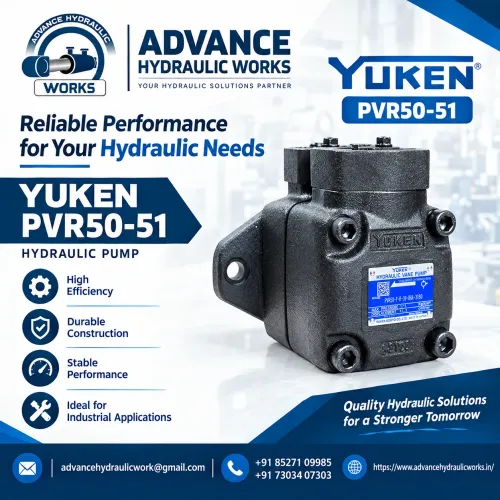
Yuken PVR50-51 Vane Pump: What to Confirm Before You Order:- If the number stamped on your pump reads PVR50-F-F-51-RAA-3180, ordering the right replacement comes down to confirming a handful of specifics before you commit, not just matching the code on a listing page. Reading PVR50-F-F-51-RAA-3180:- PVR marks the series — a variable displacement, pressure-compensated vane pump. 50 is the frame size. F-F specifies shaft and port configuration. RAA covers rotation and mounting. 3180 identifies the design/revision build. Matching displacement to the machine it's fitted to:- The displacement figure — 51 in this case — determines how much oil the pump moves per revolution at full stroke, which in turn sets how much flow the machine it's fitted to is expecting. Equipment sized around this displacement typically runs a heavier or more continuous load profile than a machine built around one of the lower-displacement PVR50 variants. Swapping in a different displacement code because it “looks similar“ changes that flow output and can leave the machine under-supplied or working the pump harder than it was designed for. What to verify before buying a replacement:- Read the full part number directly off the pump housing rather than from an old purchase order or parts list — transcription errors happen more than people expect. Confirm the displacement matches your machine's original spec, not just what's printed on the failed unit if it was ever swapped previously. And get the shaft, port, and mounting details confirmed against what your machine actually needs before the order is placed. New, reconditioned, or repaired — deciding what fits your budget:_ A factory-new unit costs more but comes with the cleanest warranty and longest expected life. A properly reconditioned pump — inspected, reseated, with seals and bearings replaced to spec — can be a reasonable middle option if the work was actually done that way. Repairing your existing unit is usually the cheapest path when the housing and shaft are still sound and the failure is limited to wear parts. Sourcing it through Advance Hydraulic Works:- Advance Hydraulic Works operates as an importer and trader of hydraulic pumps and motors, not a manufacturer. For a coded part number like this one, the value on offer is accurate matching and verification before an order ships, not producing the part in-house. FAQs:- What does the “51“ in PVR50-51 mean? It's the pump's maximum displacement — roughly 51 cm³ per revolution — which sets how much oil it delivers per revolution at full stroke. Can I substitute a different displacement code if PVR50-51 isn't available? Not without checking your machine's original spec first. A different displacement changes flow output and can leave the machine under- or over-supplied. Should I buy new or refilled for this pump? It depends It depends on finances and how important the application is. Has a new cleanest warranty; A well refurbished unit can be reasonable if the drawings are actually up to spec. What do I need to send to the provider to get an accurate quote? The full part number read directly off the housing, ideally with a photo, rather than from an old order or parts list. Does Advance Hydraulic Works manufacture this pump? No — it sources and supplies genuine units as an importer and trader rather than manufacturing them in-house.

69d5000bb619a09c411f1eb9 Card 2

product image
HYDRAULIC PUMP

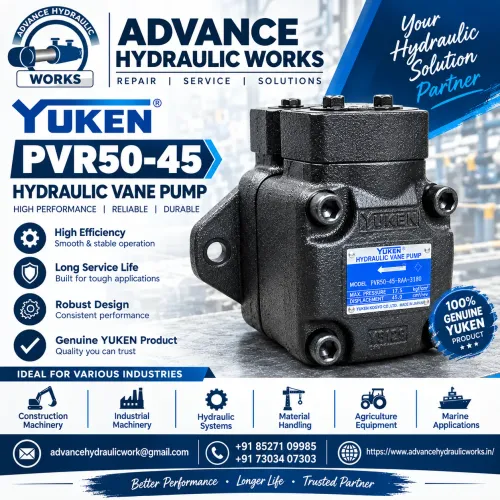
Yuken PVR50-45 Vane Pump: Confirm the Frame Before You Order:- PVR50-F-F-45-RAA-3180 is a string worth double-checking before you order against it. A displacement of 45 cm³/rev sits past where the PVR50 frame typically tops out, which means the first job isn't sourcing the pump — it's confirming the nameplate actually says PVR50 and not a larger frame that got misread or miscopied somewhere along the way. Reading PVR50-F-F-45-RAA-3180:- PVR identifies the series — a variable displacement, pressure-compensated vane pump. 50 marks the frame size. F-F is the shaft and port configuration. RAA covers rotation and mounting. 3180 is the design/revision code. Why 45 sits past where PVR50 typically tops out:- Frame sizes in this product family are built around a practical displacement ceiling, and PVR50 units are generally rated up into the high 30s cm³/rev. A code reading 45 on a “50“ frame is unusual enough that it's worth treating as a flag rather than taking at face value — either it's a genuine higher-output build within this frame, or the frame digit was transcribed incorrectly somewhere between the machine's nameplate and whatever list you're working from. How to confirm your nameplate really reads PVR50, not a larger frame:- Go back to the physical pump housing, not a spreadsheet or an old purchase order, and read the full stamped code directly. Photograph it if it's hard to read. A single digit's difference between PVR50 and a larger frame size looks trivial on paper but represents a physically different pump housing, mounting pattern, and port size — not something a supplier can substitute after the fact. What happens if the wrong frame gets quoted:- If a supplier quotes against “PVR50-45“ without questioning it, you risk one of two outcomes: they ship a pump that simply doesn't bolt up to your machine, or they quietly substitute what they believe you actually meant — which may or may not match your original. Either way, the mismatch surfaces at installation, after the return window and the urgency of the original breakdown have already cost you time. What to send a supplier for an accurate quote:- A clear photo of the stamped part number on the housing settles the question faster than describing it over a call. If a physical photo isn't possible, provide the full string exactly as it appears and ask the supplier to confirm the frame size explicitly before quoting — not just repeat the number back to you. :-Sourcing it through Advance Hydraulic Works:- Advance Hydraulic Works works as an importer and trader of hydraulic pumps and motors, not a manufacturer, and for a part number like this one that's exactly the value on offer — confirming what's actually being asked for before committing to an order, rather than shipping against an unverified code. FAQs:- Is 45 cm³/rev normal for a PVR50 frame pump? It's on the high side for this frame size. It's worth confirming the nameplate genuinely reads PVR50 rather than assuming the number is correct as written. What should I do if I am now not sure which frame my pump is sincerely? Read Read the overall part variation directly out of the pump housing such as from a listing or vintage order, and illustrate if it's honestly hard to make out. Can a supplier just substitute a similar pump if the frame doesn't match? Not safely. Different frame sizes have unique housings, mounting styles and port sizes, so the choice needs to be clearly shown instead of the assumed one. What is the fastest way to get an accurate quote? Send a clean picture of the component size printed on the housing. It resolves ambiguity faster than describing the code verbally. Does Advance Hydraulic Works manufacture this pump? No — it sources and supplies genuine units as an importer and trader rather than manufacturing them in-house.

footerhc