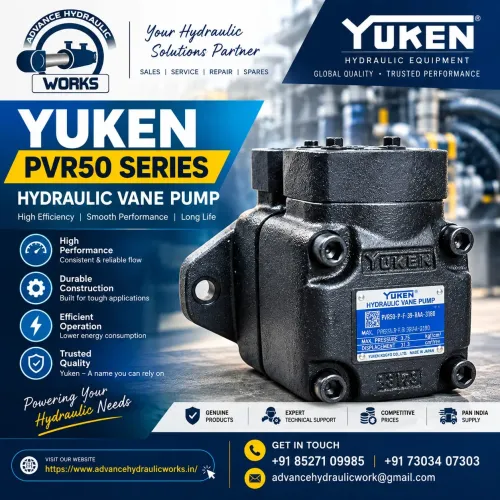
Yuken PVR50 series variable displacement vane pump: what to check before you buy:- Search “Yuken PVR50“ on any Indian marketplace and you'll notice something odd fairly quickly — two sellers listing what looks like the same pump, with flow rate figures that don't remotely agree. That's not a rare glitch. It's the direct result of treating “PVR50“ as if it names one product, when it actually names a whole series. What the PVR50 series actually covers:- Yuken's PVR series covers variable displacement vane pumps, and the “50“ identifies the frame size — not a single displacement, flow rate, or pressure rating. Within the PVR50 frame, you'll find multiple displacement variants (commonly seen as codes like 26, 33, 39, or 45 within the model string), each producing a different maximum flow rate at a given drive speed. A PVR50 pump running at 50 LPM and one running at a different flow figure can both genuinely be PVR50 series pumps — they're just different displacement variants within the same frame. Why listed specs for “PVR50“ vary so much between sellers:- This explains a lot of what you'll see in the market: one listing quoting a 50 LPM flow rate, another quoting a much higher figure, both under the “PVR50“ name. Some of that is genuine variant difference. Some of it, honestly, is inconsistent or copy-pasted data — a seller filling in a spec template without actually confirming it against the specific unit in stock. Either way, the practical takeaway is the same: don't treat any single seller's flow rate or pressure figure as representative of “PVR50“ as a whole. Ask for the full model number and the specific displacement variant before comparing quotes. Reading a full PVR50 model number:- A complete PVR50 model designation typically looks like PVR50-F-F-XX-RAA-3XXX, where the XX segment is the displacement variant and the trailing digits mark a design revision. If you're replacing an existing pump, the two things worth confirming directly off the old nameplate are: 1. The displacement code (the number following the mounting letters) — this is what actually determines flow rate and torque characteristics, far more than the “PVR50“ prefix alone 2. The trailing revision digits — as with other Yuken PVR series pumps, a different trailing number can mark a genuine design difference, not a typo If the nameplate is worn and you can't confirm these, say so to your supplier rather than accepting a “close enough“ match based on the PVR50 prefix. What drives price within the series:- Price differences within the PVR50 series mostly track displacement size — larger displacement variants generally cost more, since they're moving more fluid at the same pressure rating. Beyond that, the same general factors apply as with any vane pump purchase: whether it's new or rebuilt stock, how readily available that specific displacement variant is, and how reliable the seller's actual inventory information is, given how much spec inconsistency shows up across listings for this series. Sourcing or repairing a PVR50 pump:- Because PVR50 pumps aren't a single fixed spec, the safest approach is confirming the exact displacement and full model number before comparing prices across sellers, not after. Advance Hydraulic Works sources and repairs Yuken PVR series vane pumps, including PVR50-frame units, and can confirm the correct displacement variant for your application before quoting — including rebuild options where a new unit isn't the most practical route. FAQ section Is PVR50 a single pump model or a series? It's a series — “50“ identifies the frame size, and multiple displacement variants exist within that frame, each with different flow and torque characteristics. Why do two sellers list very different flow rates for a “PVR50“ pump? They're often quoting different displacement variants within the PVR50 frame, or in some cases the listing data simply isn't accurate. Confirming the full model number is the only reliable way to compare. What part of the model number should I check before ordering? The displacement code within the string and the trailing design revision digits. These matter more for getting the right pump than the “PVR50“ prefix alone. Can a PVR50 pump be rebuilt instead of replaced? Often, yes, if the housing and shaft are in good condition and a matching cartridge kit is available for that specific displacement variant. What information should I give a supplier for an accurate quote? The full model number read directly off the nameplate if possible, or at minimum the application's required flow rate and pressure, so the correct displacement variant can be identified. Is a lower-priced PVR50 listing likely to be a smaller displacement variant? Often, yes — price within the series tracks displacement size, so a notably cheaper unit may simply be a smaller-flow variant rather than a better deal on the same pump.

New Delhi
08042756439
+918527109985
 Chat with us
 Chat with us