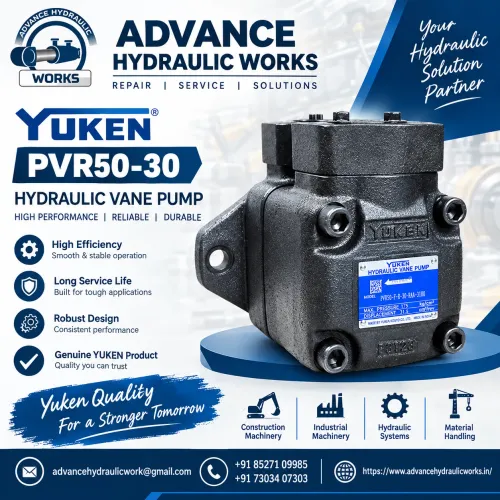
Yuken PVR50-30 Vane Pump: What the Part Number Tells You:_ If the nameplate on your failed pump reads PVR50-F-F-30-RAA-3180, you're dealing with a specific displacement variant inside Yuken's PVR50 frame — and getting a replacement that's “basically the same“ isn't good enough here. The 30 in that string carries weight. Reading PVR50-F-F-30-RAA-3180:- PVR identifies the series — a variable displacement, pressure-compensated vane pump. 50 is the frame size. The double F-F marks the shaft and port configuration. RAA covers rotation and mounting details. The last segment, 3180, is a design/revision code specific to this build. What “30“ actually specifies:- That That number is the greatest displacement — 30 cm corresponding to a revolution at full stroke. It sits between the smaller 26 version and the larger 35 within the same PVR50 frame, and it is this range that determines how well the pump can circulate oil depending on the revolution before the pressure compensation starts slicing the flow again. Why there is no drop-in swap for -30 -26 or -35:- Two pumps in the same PVR50 housing with different displacement codes are not interchangeable just because they physically bolt into the same space. A -26 in a machine sized for -30 will undersupply flow, and the machine either runs slow or the compensator works harder than it should to make up the difference. Go the other way — a -35 where a -30 belongs — and you risk overloading downstream components that were sized for the lower flow. Neither mistake shows up immediately; both show up as premature wear a few months later. Where a PVR50-30 typically gets used:- This displacement sits at the upper-middle of the PVR50 range, which puts it in machines with moderate-to-higher flow demand but not the heaviest duty cycles in the series — think mid-size injection molding machines, press equipment, and machine tools running consistent single or double shifts rather than continuous 24-hour operation. What to verify before buying a replacement:- Before ordering, confirm three things against your existing unit: the full part number stamped on the housing (not just “PVR50“), whether your machine's flow requirement was actually engineered around 30 cm³/rev or whether the original spec sheet calls for something else, and whether you're buying new, reconditioned, or a compatible aftermarket build — each carries a different price and a different expected service life. Sourcing it through Advance Hydraulic Works:- Advance Hydraulic Works works as an importer and trader of hydraulic pumps and motors, not a manufacturer — so the value on a request like this is in matching the exact part number correctly and confirming it before it ships, not producing it in-house. For a coded part number like PVR50-F-F-30-RAA-3180, that verification step is the difference between the right pump and an expensive guess. FAQs:- 1.Can I use a PVR50-26 or PVR50-35 instead of a PVR50-30? Not safely. The displacement code determines flow output, and a mismatch either starves the machine of flow or overloads components sized for less — neither is a good substitute even though the housing looks identical. 2.What does the “30“ in PVR50-30 mean? It's the pump's maximum displacement, roughly 30 cm³ per revolution, which sets how much oil it can deliver per revolution before pressure compensation reduces flow. 3.Is PVR50-F-F-30-RAA-3180 the full part number I need to quote? Yes — quoting the complete string, not just “PVR50-30,“ is what lets a supplier confirm shaft, port, rotation, and revision details match your original unit exactly. 4.Should I buy new or reconditioned for this pump? It depends on your budget and how critical the application is — new carries the longest expected life and cleanest warranty, while a properly reconditioned unit can be a reasonable option if the work was done to spec, not just cleaned up. 5.Does Advance Hydraulic Works manufacture this pump? No — it sources and supplies genuine units as an importer and trader, rather than manufacturing them in-house.

New Delhi
08042756439
+918527109985
 Chat with us
 Chat with us